

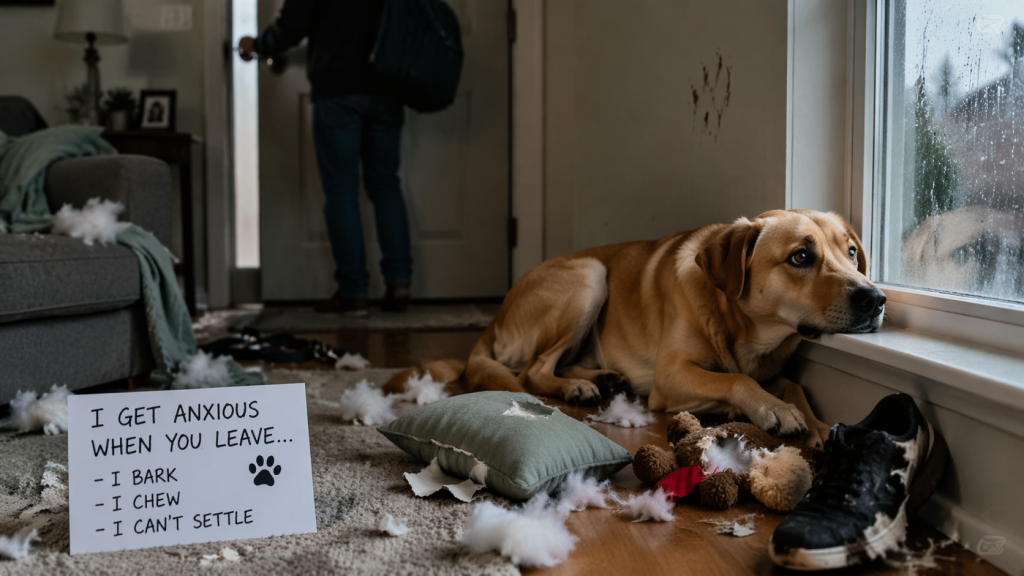
What is Separation Anxiety?
Separation anxiety is when a dog feels extreme stress or panic when they are left alone or separated from their primary human.
Why Does It Happen?
- Because dogs are not meant to live alone.
- Dogs are pack animals, not solitary animals.
But Weren’t Dogs Meant to Live in Forests?
This is where most people get confused.
❌ Myth:
Dogs are like wolves—independent, hunting alone.
✅ Reality:
Even in the wild:
- Wolves live in packs (families)
- Street dogs live in groups/territories
- They are never truly alone
Their survival depends on connection, not isolation
What Changed in Domestic Life?
When a dog comes into a home we become their pack. We are their security, their routine and their emotional anchor. Now imagine, they are always with you then suddenly you disappear for hours. Their brain doesn’t think “Owner/My pack will come back at 6 PM.”
It thinks:
“My pack is gone. Am I safe?”
Why Some Dogs Develop It More
Not all dogs get separation anxiety.
Over-Attachment
- No independence training
Sudden Change in Routine
- Work from home → office shift
- New house
- New environment
Rescue / Indie Background
- Fear of abandonment
- Past trauma
- Survival insecurity
Lack of Mental & Physical Activity
- Excess energy
- Boredom → anxiety
How to Prevent & Manage Separation Anxiety in Dogs
Build Independence when they are puppies (2 months at least). Most anxiety starts because the dog is never used to being alone.
Do this:
- Give your dog some time in another room daily
- Don’t let them follow you everywhere
- Encourage them to rest on their own bed
- Practice short departure. Step out for 5–10 minutes, then 20 minutes and then 1 hour. Increase gradually so the dog learns
- Stick to your routines like walk time, mealtime and sleep time.
- Most people make this mistake. Dramatically saying “Bye baby, I’ll miss you” and then over-excitement when returning.
Instead:
Leave calmly and return calmly. Greet after 5–6 minutes when pet is relaxed. This removes emotional spikes.
Most Important
Mental Stimulation Before Leaving
A bored dog = anxious dog
Before you leave:
- Take them for a walk
- Play for 15–20 minutes
- Do a small training session
A tired dog is more likely to rest instead of panic. Don’t punish anxiety behavior. If your pet barks, chews things or cries. It’s not misbehavior—it’s stress. Separation anxiety doesn’t mean your pet is weak. It means your pet is deeply attached to you.
Your job is not to reduce love—
👉 it’s to build confidence alongside that love.
Pukhraj Dhatt
Founder, The Dogfather-A Pet Hostel